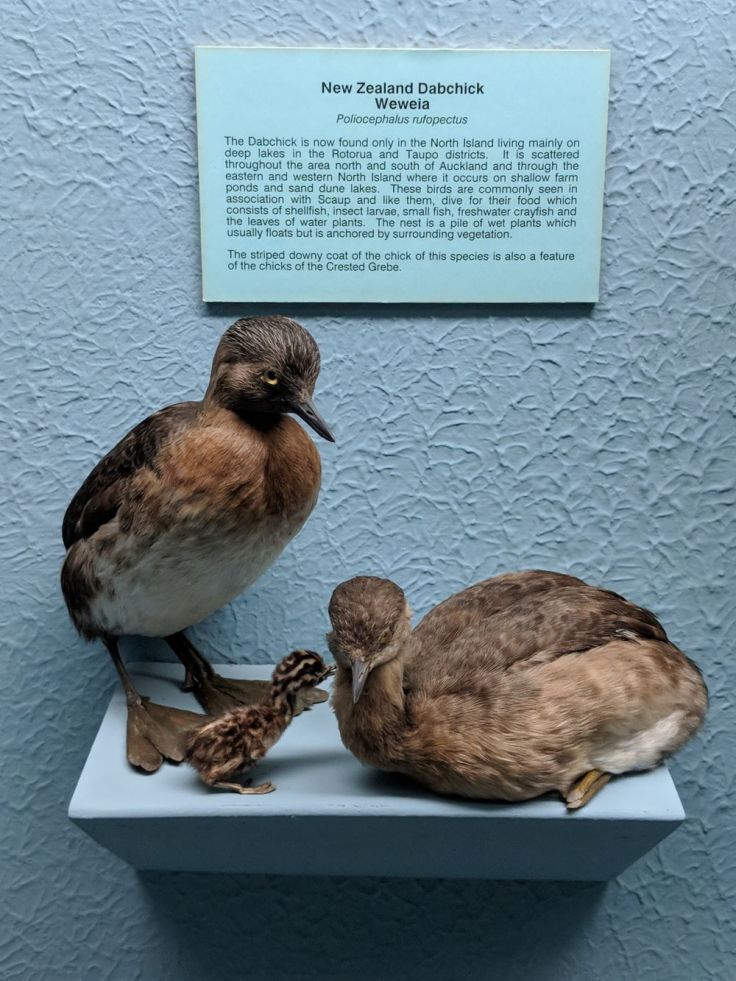
“The Dabchick is now found only in the North Island living mainly on deep lakes in the Rotorua and Taupo districts. It is scattered throughout the area north and south of Auckland and through the eastern and western North Island where it occurs on shallow farm ponds and sand dune lakes. These birds are commonly seen in association with Scaup and like them, dive for their food which consists of shellfish, insect larvae, small fish, freshwater crayfish, and the leaves of water plants. The nest is a pile of wet plants which usually floats but is anchored by surrounding vegetation. The striped downy coat of the chick of this species is also a feature of the chicks of the Crested Grebe.
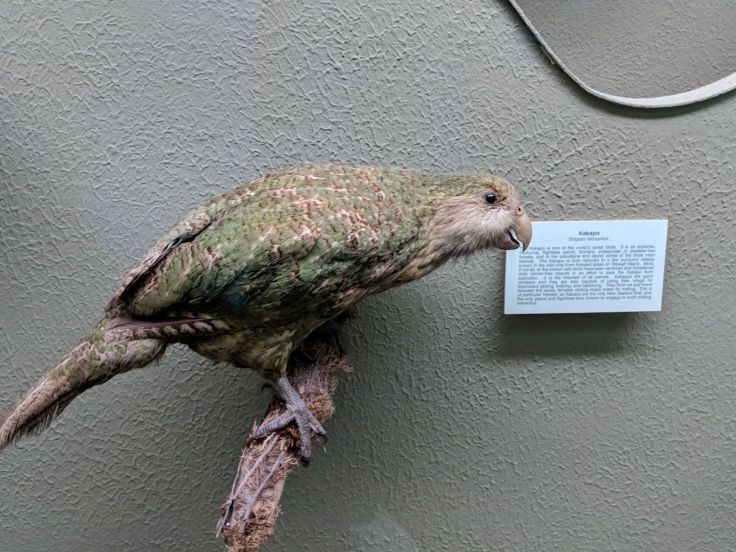
Seen rather uncomfortably closely by Stephen Fry on Last Chance to See.
“The Kakapo is one of the world’s rarest birds. It is an endemic, nocturnal, flightless parrot, formerly widespread in predator-free forests, and in the sub-alpine and alpine zones of the three main islands. The Kakapo is now reduced to a few survivors reliably known in the wild only from forested areas on Stewart Island. Most, if not all, of the known wild birds have been removed and transferred onto vermin-free islands in an effort to save the Kakapo from extinction. It is the heaviest of all parrots. Kakapos are good climbers and they are also capable of using their wings for downward gliding, braking, and balancing. They form no pair-bond between the sexes, females visiting makes solely for mating. This is of particular interest, as Kakapo are the only New Zealand bird, and the only parrot and flightless bird, known to engage in such mating behavior.”
Birds as visited in the Canterbury Museum in Christchurch.
 Book and Ladder
Leave a comment